
Mending the Sacred Hoop, Inc. is a Native-led non-profit organization dedicated to addressing and ending violence against Native relatives. We organize on issues surrounding violence against American Indian/Alaska Native relatives in our home community of Duluth, MN and throughout the State of Minnesota. Nationally we work with Tribes and Native communities that are addressing the issues of domestic and sexual violence, dating violence, sex trafficking and stalking in their communities. We provide training to strengthen Tribal and Native community responses to these crimes, including advocacy and systems responses, community understanding and awareness, engaging our relatives in the work to end violence against our relatives, and coordinating community responses that provide safety and uphold offender accountability.
WHAT FRAMES OUR WORK
Native women are the highest victimized population in the United States by perpetrators of all races. (Bureau of Crime Statistics, U.S. Department of Justice. American Indians and Crime Report. Washington: 1999).
Violence against women is a social problem that affects individuals, families, and communities (including schools, medical, and judicial institutions), and as such, requires societal change.
Colonization is based in a belief that one group has the right to exert their will over another and use people and resources for their own gain.
Domestic and sexual violence is about establishing power and maintaining control.
Acculturated values and beliefs have eroded our Indigenous structures and lifeways.
We must reclaim our own Indigenous teachings on culture and values to create social change in and for our communities.

OUR MISSION
Mending the Sacred Hoop works from a social change perspective to end violence against our Native relatives and children while restoring the safety, sovereignty, and sacredness of Native women. We are dedicated to strengthening the voice and vision of Native peoples. Our approach is founded on grassroots organizing within communities, restoring the leadership of Native women in addressing domestic and sexual violence.
OUR LOGO
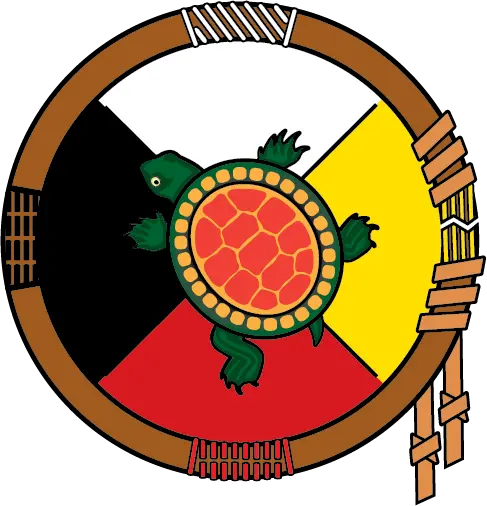
The Hoop, or Circle is one of the most powerful Native American symbols for wellness and creative problem-solving. It represents wholeness, health, and harmony with self, family, community, nation, and the universe.
Mending the Sacred Hoop’s logo references Indigenous people healing from the devastating effects of European migration. The Sacred Hoop, broken by the effects of colonization, is being mended, beginning in the seventh generation.
Our logo represents the healing of our communities based on the teachings of the Medicine Wheel. Each section of the Medicine Wheel represents one of the four cardinal directions with a corresponding color. The outer rim shows the Hoop as being broken, and the ribbon signifies our work – we are in the process of mending the Sacred Hoop. The turtle represents Earth, North America/Turtle Island, wisdom, longevity, and woman. As women are at the center of our work, our families, and our communities we place the turtle in the center of the Sacred Hoop.
SACRED HOOP COALITION
Sacred Hoop Tribal Domestic Violence Coalition organizes to raise the voices of Native relatives throughout Minnesota, building the capacity of survivors, advocates, Native organizations, and victim service providers to end intimate partner violence against American Indian relatives.
OUR STAFF

Cinnamon Bankey
Executive Director
Rebecca Balog
Training and Technical Assitance Program Development Coordinator
Natasha Kingbird
Operations Coordinator